

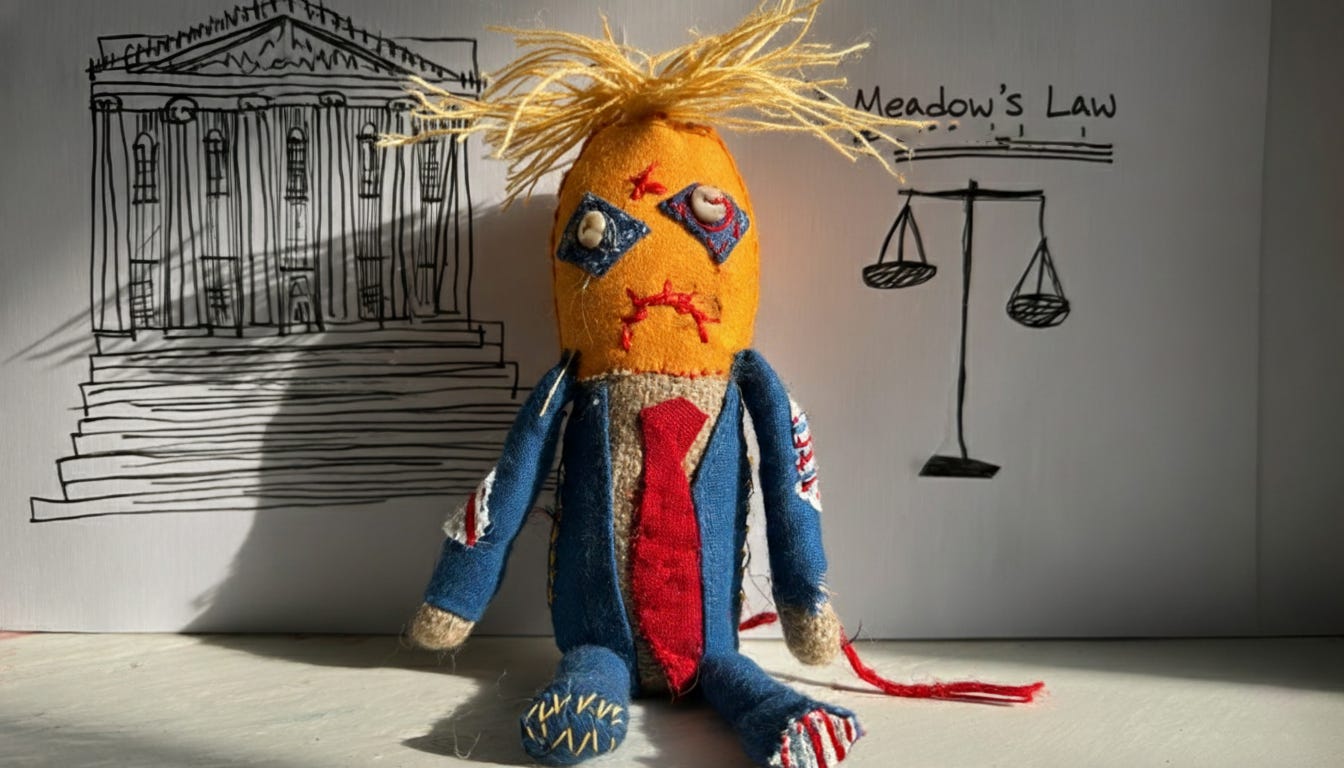
“Beyond a reasonable doubt” does not mean beyond all doubt. It means beyond doubt that remains reasonable after evidence is weighed in total.
You are a juror. Not in a literal courtroom—at least not yet—but in the court of civic judgment where citizens must evaluate the character and conduct of their leaders. This is not a legal proceeding. This is an exercise in modeling reasonable thought: how an informed observer integrates repeated allegations, documented associations, and adjudicated findings over time.
Every citizen performs this process, whether consciously or not. We do it when evaluating leaders, institutions, and people entrusted with power. The question is not whether absolute certainty is possible. The question is: what standard of belief becomes reasonable once evidence accumulates?
The Hospital Administrator Analogy
Imagine a senior hospital administrator who, over forty years, is repeatedly linked to environments where patient abuse occurs. Nurses, orderlies, and junior physicians independently report failures of supervision in facilities under his control. The administrator denies personal wrongdoing and insists he was never directly involved.
At the same time, he publicly praises “rule-bending” clinicians, maintains close professional relationships with doctors later convicted of abuse, and repeatedly restructures oversight systems in ways that weaken reporting. Internal audits flag the same failures again and again. No single document proves the administrator personally harmed a patient.
Still, a reasonable observer must ask: after accounting for scale, visibility, and authority, how plausible is coincidence as an explanation for decades of the same pattern?
This is not purely hypothetical. It has happened repeatedly.
Mid Staffordshire NHS: When the Pattern Was Real
Between 2005 and 2009, at Mid Staffordshire NHS Foundation Trust in England, somewhere between 400 and 1,200 patients died due to systemic neglect. Staff repeatedly raised concerns about unsafe staffing levels, hygiene failures, and inadequate care. Hospital executives prioritized financial targets and institutional reputation over patient safety.
The 2013 Francis Report—a comprehensive independent inquiry—concluded there was “a culture of denial and intimidation” at the leadership level. Senior executives claimed they had no personal knowledge of specific harms. No single document showed a CEO or board member directly harming a patient.
Yet the inquiry found institutional leadership accountable. Why?
Repeated warnings were ignored over years
Structural systems suppressed reporting from frontline staff
Leadership decisions consistently prioritized reputation over investigation
Pattern persistence made coincidental ignorance implausible
The Francis Report established that after a certain density of warning signals, leadership’s claim of “no direct knowledge” becomes unreasonable. The pattern itself becomes evidence.
VA Hospital Scandal: The Pattern Repeats in America
Just one year after the Francis Report, the same pattern emerged in the United States.
In 2014, investigations revealed that multiple Veterans Affairs hospitals had systematically falsified wait-time records, leading to delayed care, preventable harm, and patient deaths. Whistleblowers had raised concerns for years. The Phoenix VA alone was linked to the deaths of 40 veterans who died while waiting for appointments that never came.
Hospital administrators denied wrongdoing. They emphasized their adherence to performance metrics. They claimed no knowledge of the specific manipulations occurring under their oversight.
Independent audits told a different story. The VA’s own Inspector General found that administrators had created incentive structures that rewarded falsification and punished honest reporting. Wait-time targets became more important than actual patient care. Staff who raised concerns were marginalized or retaliated against.
Once again, the pattern mattered more than any single memo:
Internal audits had flagged problems for years before public exposure
Leaders denied intent while maintaining the structures that enabled harm
Structural incentives directly caused deaths
No single document proved administrators personally falsified records or harmed veterans
Yet institutional accountability was assigned. The VA Secretary resigned. Multiple senior administrators were removed. The pattern of ignored warnings, structural suppression, and prioritization of metrics over safety made claims of innocent ignorance implausible.
The Framework Applied Consistently
These cases establish a principle: When patterns persist despite repeated warnings, coincidental ignorance becomes an increasingly strained explanation.
This analogy does not accuse Trump of the same crimes as hospital executives. It models how responsibility and credibility are assessed when patterns—not isolated acts—persist across time and context.
The question is not whether Trump personally committed every alleged act. The question is whether, after accounting for his visibility and wealth, the accumulated pattern of allegations, associations, access-enabling environments, and his own statements remains plausibly explained by coincidence and ignorance.
Mid Staffordshire and the VA scandal show us how reasonable observers assess such patterns in practice. After a certain threshold of repeated signals, “I didn’t know” stops being a defense and becomes part of the evidence.
That is the framework reasonable observers use when patterns accumulate.
The Independence Baseline
When someone faces 28 accusations of sexual misconduct, a reasonable person’s first reaction is to treat them as separate signals. This is not because independence is literally true, but because it reflects how we initially measure information. Each additional report feels like added evidence.
This baseline intuition is legitimate. It is also incomplete.
In 1999, British pediatrician Roy Meadow coined what became known as “Meadow’s Law”—the principle that one sudden infant death is a tragedy, two is suspicious, and three is murder until proven otherwise. The law was later discredited for misapplying probability, but the underlying logic remains: independent, repeated patterns suggest causation, not coincidence.
The U.S. Federal Rules of Evidence acknowledge this. Rules 413 and 415 allow courts to admit evidence of prior sexual assaults because pattern behavior is probative. The legal system recognizes what common sense confirms: when similar allegations accumulate from independent sources, treating each as isolated becomes untenable.
But reasonable thought does not stop at naive independence calculations.
Confounding and Adjustment
A reflective observer immediately asks: are there factors that could inflate the number of allegations without implying wrongdoing? These are confounders—variables that affect both exposure and reporting.
For a confounder to matter, it must meet three conditions:
It plausibly affects access or exposure
It plausibly affects reporting or visibility
There is evidence it operates this way
Fame, wealth, power, and long public exposure satisfy these criteria.
Famous people attract attention and false claims. Wealth suppresses legitimate claims through legal pressure and NDAs. Authority creates asymmetry—enabling access while delaying accountability. Long public exposure increases both genuine opportunity and background noise.
A reasonable model adjusts mentally for these factors. Failing to do so would itself be unreasonable.
Adjustment Has Limits
Adjustment explains some inflation. It does not explain everything.
If fame alone accounted for repeated allegations, we would expect similar patterns across similarly exposed figures. We do not see that consistently. If wealth explained persistence, we would expect allegations to dissipate under legal pressure. In many cases, they intensify.
Moreover, adjustment cuts both ways. While fame increases visibility, it also increases the cost and risk of making false accusations against powerful figures. Wealth enables not just suppression of false claims, but systematic silencing of true ones.
The question becomes: After honest adjustment for confounders, does coincidence remain the most economical explanation?
This is not a legal standard. It is an epistemic one.
The 28-Witness Problem
Since the 1970s, at least 28 women have publicly accused Donald J. Trump of sexual misconduct. These allegations span five decades, involve women who never knew each other, and describe a remarkably consistent pattern: unexpected physical aggression, often involving forcible kissing or groping, typically leveraging situations where Trump held positional power.
Let’s model this conservatively. The FBI estimates false reporting rates for sexual assault at 2-8%. Let’s triple that to 30%—a figure with no empirical support but maximally generous for adjustment purposes.
Even at a 30% false accusation rate, the probability of 28 independent false accusations is:
P(all false) = (0.30)^28 ≈ 2 × 10^-13
That’s 0.00000000002%.
But this treats accusations as truly independent, which they’re not after the first few become public. Later accusers know about earlier ones. Some may be encouraged by solidarity; some may be influenced by publicity.
So let’s adjust dramatically. Suppose the first five accusations are independent, but each subsequent accusation has only a 50% chance of being truly independent—the rest are either copycat claims or encouraged by earlier reports.
Even with this severe adjustment, you’re modeling approximately 16 independent events. At our generous 30% false rate:
P(all false) = (0.30)^16 ≈ 4 × 10^-9
That’s still one in 250 million.
Adjustment matters. But adjustment has mathematical limits.
The Judicial Verdict
On May 9, 2023, a jury found Trump liable for the sexual abuse and defamation of writer E. Jean Carroll. The jury awarded her $5 million. When Trump continued to defame Carroll, a second jury awarded her $83.3 million in January 2024. The Second Circuit Court of Appeals upheld both verdicts in December 2024.
This was not a criminal conviction. But it was an adjudicated finding by a jury of Trump’s peers, based on testimony from Carroll and corroborating witnesses. Federal Rules of Evidence 413 and 415 allowed testimony from other Trump accusers—Jessica Leeds and Natasha Stoynoff—describing similar patterns of behavior.
Judge Lewis Kaplan clarified that while the jury used New York’s narrow statutory definition of “rape,” the conduct they found proven—forcible digital penetration—”is commonly understood as rape.”
This is not an allegation. This is a verified legal finding.
The Epstein Entanglement
Now we layer another variable: documented, long-term proximity to a convicted child sex trafficker.
Jeffrey Epstein himself told journalist Michael Wolff that he and Trump had been “closest friends for ten years.” This wasn’t casual acquaintance. Photographs, videos, and flight logs document decades of association: partying at Mar-a-Lago in 1992, attending Victoria’s Secret fashion shows together, traveling on Epstein’s private aircraft.
In 2002, Trump told New York Magazine: “I’ve known Jeff for 15 years. Terrific guy. He’s a lot of fun to be with. It is even said that he likes beautiful women as much as I do, and many of them are on the younger side.”
Read that carefully. “On the younger side.” Trump knew. He said so publicly, six years before Epstein’s first conviction.
Could this be coincidence? Could someone with 28 accusations also be—purely by chance—best friends for a decade with the world’s most notorious child sex trafficker, while publicly acknowledging knowledge of that person’s preferences?
Mathematically possible? Yes.
Reasonably plausible after adjustment? That becomes harder to sustain.
The Mar-a-Lago Recruitment Ground
In summer 2000, Virginia Giuffre, age 16, was working at the Mar-a-Lago spa when Ghislaine Maxwell recruited her into Epstein’s trafficking operation. Giuffre spent years being sexually exploited and trafficked to powerful men around the world.
On July 29, 2025, Trump himself admitted that Epstein had “stolen” young women from his Mar-a-Lago spa, specifically naming Giuffre as one of those “taken out.”
Consider what this admission means. Trump knew recruitment was happening on his property. He framed it as theft—”my employees were poached”—but mentions neither calling police nor intervening. The Giuffre family expressed shock at this framing. Their daughter wasn’t “stolen inventory.” She was a child being trafficked from property Trump controlled.
Could this be innocent oversight? Possibly.
Does that explanation become more or less plausible when combined with the other evidence?
The Pageant Access
Between 1996 and 2015, Trump owned the Miss Universe, Miss USA, and Miss Teen USA pageants. At least five former Miss Teen USA contestants—some as young as 15—alleged that Trump entered their dressing rooms while they were undressed.
In 2005, Trump told Howard Stern: “I’ll go backstage before a show, and everyone’s getting dressed and ready... no men are anywhere. And I’m allowed to go in because I’m the owner of the pageant. And therefore I’m inspecting it.”
He continued: “You know, they’re standing there with no clothes... and you see these incredible-looking women, and so, I sort of get away with things like that.”
“I sort of get away with things like that.”
This is not an allegation requiring verification. This is Trump’s own description of using ownership to bypass privacy norms for teenage girls.
The 3.5 Million Pages
When the Epstein Files Transparency Act forced the Department of Justice to release investigative files in 2025-2026, approximately 3.5 million pages of documents, 180,000 images, and 2,000 videos became public.
Trump’s name appears more than 1,500 times in these files.
Not in passing. In flight logs showing previously undisclosed travel. In emails where Epstein used Trump’s name. In FBI interview notes from alleged victims. In witness statements describing encounters at Mar-a-Lago, at Epstein’s townhouse, at events spanning decades.
The DOJ issued a statement claiming some allegations against Trump are “unfounded and false.” But they didn’t specify which ones. They didn’t provide evidence. They issued a blanket disclaimer while releasing millions of pages of unverified allegations about dozens of others.
This is selective editorialization without evidentiary support.
One document—FBI case file EFTA00020517 from October 2020—details a tip from a limousine driver who claimed he overheard Trump discussing “abusing some girl” with “Jeffrey” in 1995. The driver alleged a woman later told him she’d been raped by both men. She was found dead in Kiefer, Oklahoma in January 2000—ruled suicide, though the driver and officers reportedly believed otherwise.
Is this specific tip verified? No.
But it exists within a constellation of similar reports. When a name appears 1,500 times in files documenting sex trafficking, dismissing any single allegation as “unfounded” while providing no systematic verification framework is not transparency—it’s statistical arbitrage.
The “I Wish Her Well” Signal
On July 21, 2020, shortly after Ghislaine Maxwell was arrested for sex trafficking minors, Trump was asked about her case.
He responded: “I’ve met her numerous times over the years, especially since I lived in Palm Beach... But I wish her well, frankly.”
Ghislaine Maxwell was arrested for trafficking children. Trump wished her well.
Compare this to Trump’s treatment of the Central Park Five—teenagers later proven innocent whom he called for to be executed, refusing to apologize even after exoneration.
This is Trump’s “transactional DNA”: defending those who don’t attack him, regardless of their crimes. It’s not proof of criminal complicity. But it is data about character and association.
A Reader Exercise: Testing the Framework
Before proceeding to conclusions, test this framework yourself on cases where the outcome is now known. Go back in time. Imagine you are assessing these situations before the full truth emerged, using only the pattern evidence available at the time.
Ask yourself: Would this framework have helped you reach a reasonable conclusion earlier?
Penn State & Jerry Sandusky (1998-2011)
The Pattern That Was Visible:
Multiple reports reached senior administrators over more than a decade that assistant football coach Jerry Sandusky was abusing minors
A 1998 police investigation into Sandusky showering with a boy was known to leadership
In 2001, a graduate assistant reported witnessing Sandusky sexually assaulting a boy in the showers
Leaders repeatedly chose quiet internal handling over reporting to authorities
Sandusky retained access to Penn State facilities and continued working with children through his charity
What Leadership Said:
University President Graham Spanier, Athletic Director Tim Curley, and VP Gary Schultz all denied personal wrongdoing
They claimed they didn’t understand the reports as describing abuse
They emphasized Sandusky’s stellar reputation and decades of service
They said they handled matters appropriately and followed protocol
What the Pattern Showed: Before Sandusky’s 2011 arrest, the pattern included: repeated warnings over 13 years, consistent access to vulnerable populations, leadership decisions that prioritized reputation over investigation, and structural choices that reduced external reporting.
The Freeh Report (2012) Later Concluded: “The most saddening finding is the total disregard for the safety and welfare of Sandusky’s child victims by the most senior leaders at Penn State. The most powerful men at Penn State failed to take any steps for 14 years to protect the children who Sandusky victimized.”
Spanier was later convicted of child endangerment (later overturned on procedural grounds, but findings of institutional failure remain undisputed).
Apply the Framework: After adjusting for Sandusky’s reputation, the football program’s cultural power, and the initial ambiguity of some reports, does coincidental ignorance remain the most plausible explanation for 13 years of non-action?
Michigan State University & Larry Nassar (1997-2016)
The Pattern That Was Visible:
Hundreds of young athletes reported concerns about team doctor Larry Nassar’s “treatments” over nearly two decades
Complaints were repeatedly dismissed, reframed as medical misunderstandings, or buried
Multiple formal Title IX complaints were filed and closed without action
Nassar retained his position, authority, and access to young athletes
What Leadership Said:
MSU administrators denied knowledge that Nassar’s conduct constituted abuse
They praised his professional credentials and medical expertise
They trusted the established doctor over young complainants
They insisted they followed proper review procedures
What the Pattern Showed: Before Nassar’s 2016 arrest, the pattern included: complaints dating to 1997, at least 14 known reports to MSU authorities, survivors being told they “didn’t understand” the medical procedures, and structural barriers that made reporting difficult and discouraged follow-through.
Independent Investigations Later Found: Systematic institutional failure across multiple layers of administration. Multiple MSU administrators resigned. The university paid $500 million to survivors. Michigan’s Attorney General concluded that MSU’s “culture of indifference” enabled Nassar’s abuse.
Apply the Framework: After adjusting for medical authority, the power differential between doctor and young patients, and the initial plausibility of “misunderstanding medical procedures,” does coincidental oversight failure remain the most plausible explanation for two decades of dismissed complaints?
U.S. Catholic Church Abuse Crisis (1950s-2002 exposure)
The Pattern That Was Visible:
Abuse by priests occurred for decades across multiple dioceses
Bishops received repeated reports about specific priests
Accused priests were moved to new parishes rather than removed
Church records documenting complaints were kept sealed
Victims were encouraged to remain silent “for the good of the Church”
What Leadership Said:
Bishops denied personal involvement in abuse
They characterized accused priests as having individual failings requiring pastoral care
They emphasized the small percentage of priests involved
They claimed they were following therapeutic advice of the era by reassigning rather than removing
What the Pattern Showed: Before the Boston Globe’s Spotlight investigation in 2002, evidence existed of: repeated complaints across decades, systematic reassignment of accused priests, sealed records, financial settlements with confidentiality clauses, and institutional decisions that consistently prioritized reputation over victim protection.
Investigations Later Revealed: The issue was never just “bad individual priests.” Records showed bishops had knowledge of abuse, made deliberate decisions to conceal it, and created structures that explicitly reduced accountability. Grand jury reports across multiple states documented institutional complicity.
Apply the Framework: After adjusting for the Church’s hierarchical structure, cultural deference to religious authority, and the therapeutic misconceptions of earlier eras, does coincidental institutional ignorance remain the most plausible explanation for decades of pattern persistence?
What These Cases Teach Us
In all three cases, the pattern evidence was visible before full public exposure. In all three, leadership claimed no personal wrongdoing while maintaining relationships and structures that enabled continued harm. In all three, institutional investigators later concluded that the pattern itself was evidence—that after a certain threshold of signals, “we didn’t know” became implausible.
The framework you’ve been reading was not designed for Donald Trump. It’s how institutional accountability is assessed across contexts. When patterns persist despite warnings, when access continues despite concerns, when reputation is prioritized over investigation—reasonable observers eventually conclude that coincidence has exceeded its explanatory limits.
The question is not whether this framework is fair. The question is whether you would apply it consistently.
Now return to the Trump evidence with this framework in mind.
The Residual Question
After adjusting for fame, wealth, power, and long exposure, the remaining question is simple:
Does coincidence still provide the most plausible explanation?
Here is what remains after reasonable adjustment:
28 independent accusations spanning 50 years with consistent patterns
Civil jury verdict finding liability for sexual abuse, upheld on appeal
15-year acknowledged friendship with Epstein, with public knowledge of his preferences
Mar-a-Lago used as recruitment ground for confirmed trafficking victim
Recorded admission of invading teen dressing rooms as ownership “perk”
1,500+ mentions in Epstein investigative files
Public goodwill toward Epstein’s convicted co-conspirator
Answering “yes, still coincidence” requires compounding assumptions:
Dozens of unrelated women fabricated similar accounts
A jury erred despite corroborating testimony
Repeated access-enabling environments were incidental
Explicit recorded statements were jokes
Long-term associations with a trafficker were meaningless
1,500 file mentions are all explainable
Each auxiliary assumption may be possible. Together, they strain plausibility.
Beyond Reasonable Doubt (Properly Understood)
“Beyond a reasonable doubt” does not mean beyond all doubt. It does not mean beyond every conceivable alternative. It means beyond doubt that remains reasonable after evidence is weighed in total.
This essay does not claim legal guilt. It models how reasonable thought operates when patterns persist despite adjustment.
Compare two explanations:
Explanation A: All 28 women are lying or mistaken, the jury was wrong, the Epstein friendship was innocent, the Mar-a-Lago recruitment was unknowing, the dressing room statements were jokes, the 1,500 file mentions are coincidental.
Explanation B: The pattern evidence reflects reality, adjusted for the confounding effects of fame, wealth, and exposure.
Neither explanation is certain. But after honest adjustment, which requires fewer and less strained assumptions?
At some point, denial ceases to be a neutral position and becomes an increasingly complex hypothesis requiring more auxiliary assumptions than the alternative.
The Standard of Reasonable Belief
Reasonable belief does not require certainty. It requires that the explanation offered be more plausible than its alternatives after fair adjustment.
Legal systems acknowledge this through pattern evidence rules. Institutional oversight investigations acknowledge this through accumulated audit findings. Historical retrospectives acknowledge this when explaining how abuse persisted: not because of a single smoking gun, but because warnings were ignored, associations were tolerated, and power enabled access.
The question reasonable observers face is not: “Can I imagine an innocent explanation?”
The question is: “After adjusting for confounders, does that explanation remain more plausible than the pattern interpretation?”
Conclusion: When Doubt Becomes Unreasonable
Patterns do not prove guilt. But neither are they epistemically inert.
When repeated allegations, adjudicated findings, documented associations, and the subject’s own statements align across decades, reasonable thought does not demand certainty. It asks whether coincidence remains plausible after honest adjustment.
When it no longer does, belief shifts—not because doubt is impossible, but because continued doubt has become unreasonable.
That is not a legal verdict.
That is how responsible judgment works.
All facts, quotes, and figures in this article are drawn from court records, DOJ releases under the Epstein Files Transparency Act, contemporaneous media interviews, appellate decisions, and documented institutional investigations. No names, events, or allegations have been fabricated.